Layering oscillators into a fuller sound
A single oscillator makes a thin sound. Most rich patches are several sound sources stacked: oscillators at different octaves, a sub for weight, noise for air, spread wide with unison. This guide is about combining the sources Kiwisynth gives you into one fuller sound. The oscillator and filter feature pages cover each control in full.
The sources you have to stack
Kiwisynth has three main oscillators, a sub oscillator and a noise source. Each fills a different role in a layered sound.
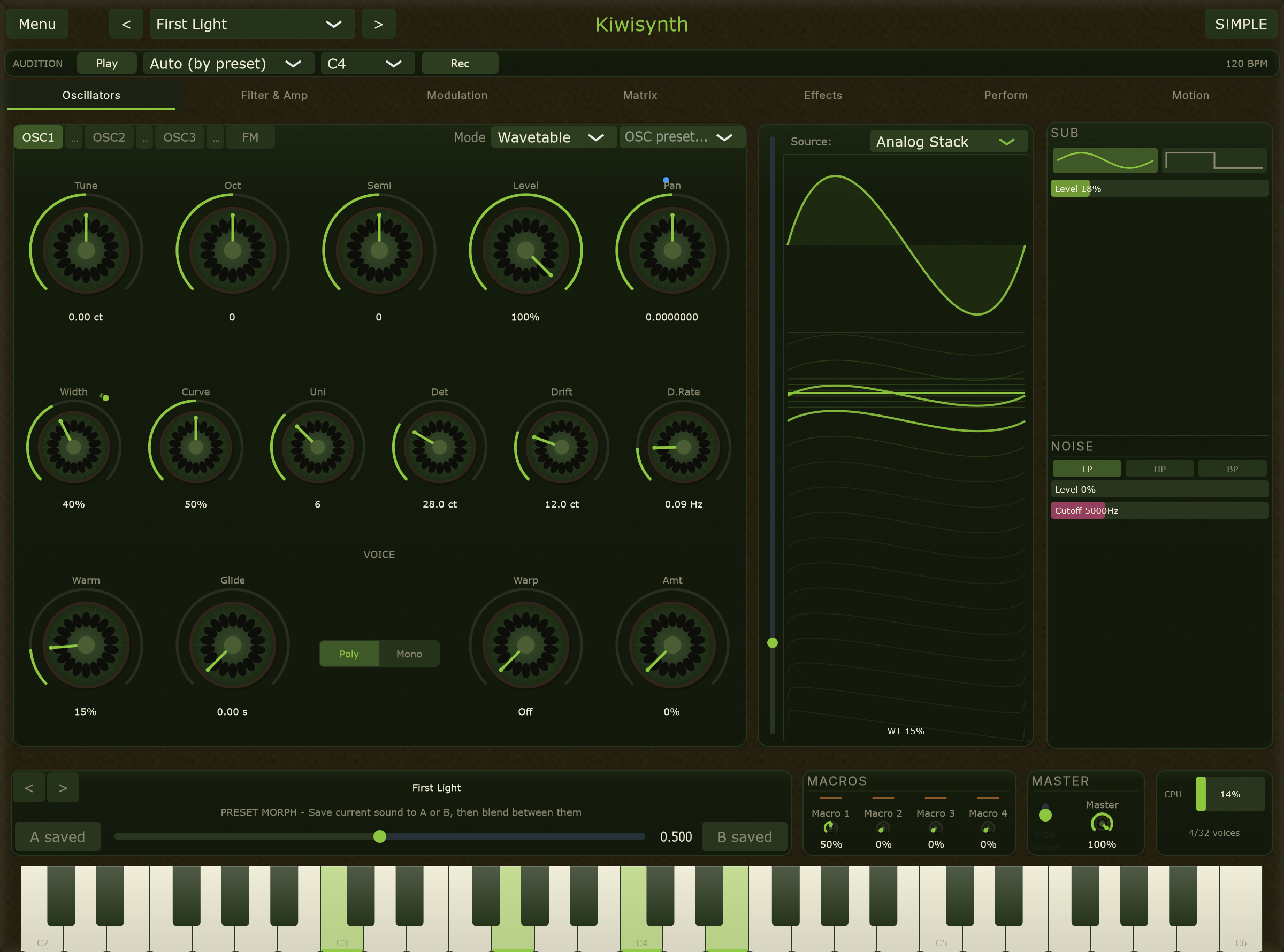
- The three oscillators are the body. Give them different waveforms or octaves so they reinforce each other rather than doubling the same thing.
- The sub sits an octave or two below and adds weight and low end. It is felt more than heard, and it anchors a bass or thickens a lead.
- Noise adds air, breath and attack. A little goes a long way: it fills the gaps the tuned sources leave and makes an attack feel real.
See oscillators for what each mode and waveform sounds like.
Octave and tuning relationships
How you tune the layers against each other decides whether they fuse or clash.
- Octaves fuse. Put one oscillator an octave above another and they read as one brighter sound, not two notes.
- Fifths and other intervals are heard as harmony, so use them deliberately, for an organ-like stack, not by accident.
- Small detune, a few cents apart, makes two oscillators beat slowly against each other. This is the thickening at the heart of most wide sounds, and it costs nothing but a little tuning.
Unison and width
Unison stacks several copies of an oscillator and detunes them across the stereo field. It is the fastest way to a big, wide sound: a supersaw lead or a huge pad. More voices and more detune mean a wider, lusher sound, up to the point where it smears; pull the detune back if the pitch stops being clear. Keep the sub and any percussive attack out of the unison so the low end and the transient stay centred and tight.
Routing the layers through the filters
Two filters and three routings decide how the stack is shaped. This is where layering goes beyond simply turning sources up.
- Series runs everything through both filters in turn, for a single strong tonal shape over the whole stack.
- Parallel splits the signal through both filters and sums them, for two tonal colours at once.
- Split sends one group of sources through one filter and another group through the other. Use it to shape parts of the stack separately: keep the sub and one oscillator dark and round while the others stay bright, for example.
See filter for the routing and the filter models.
Balancing the stack
A layered sound only works if the levels are right. Build it up one source at a time rather than turning everything up at once.
- Start with the source that carries the identity of the sound and set its level. Add each other source underneath it, only as loud as it needs to be to do its job.
- Watch the low end. The sub and the lowest oscillator compete; if the patch sounds muddy, one of them is too loud or they are too close in pitch.
- If two sources fight for the same space, move one an octave away or filter one darker so each owns a different part of the spectrum.
A fuller sound is not a louder one. It is several sources each doing a clear job, balanced so the ear hears one instrument rather than a pile of oscillators.