Chord
The Chord page turns one key press into a stack of notes. It sits on the Perform page, ahead of the arpeggiator, so the arp then arpeggiates whatever the chord stage built.
It is off by default. A patch that never switches it on plays exactly as it did before the chord stage existed.
The page holds two blocks. The chord controls decide what stack a key becomes. The key, scale and tuning controls decide what "in key" means, and they are used by more than the chord stage: a script's scale functions read them, and the tuning table retunes every note the synth plays.
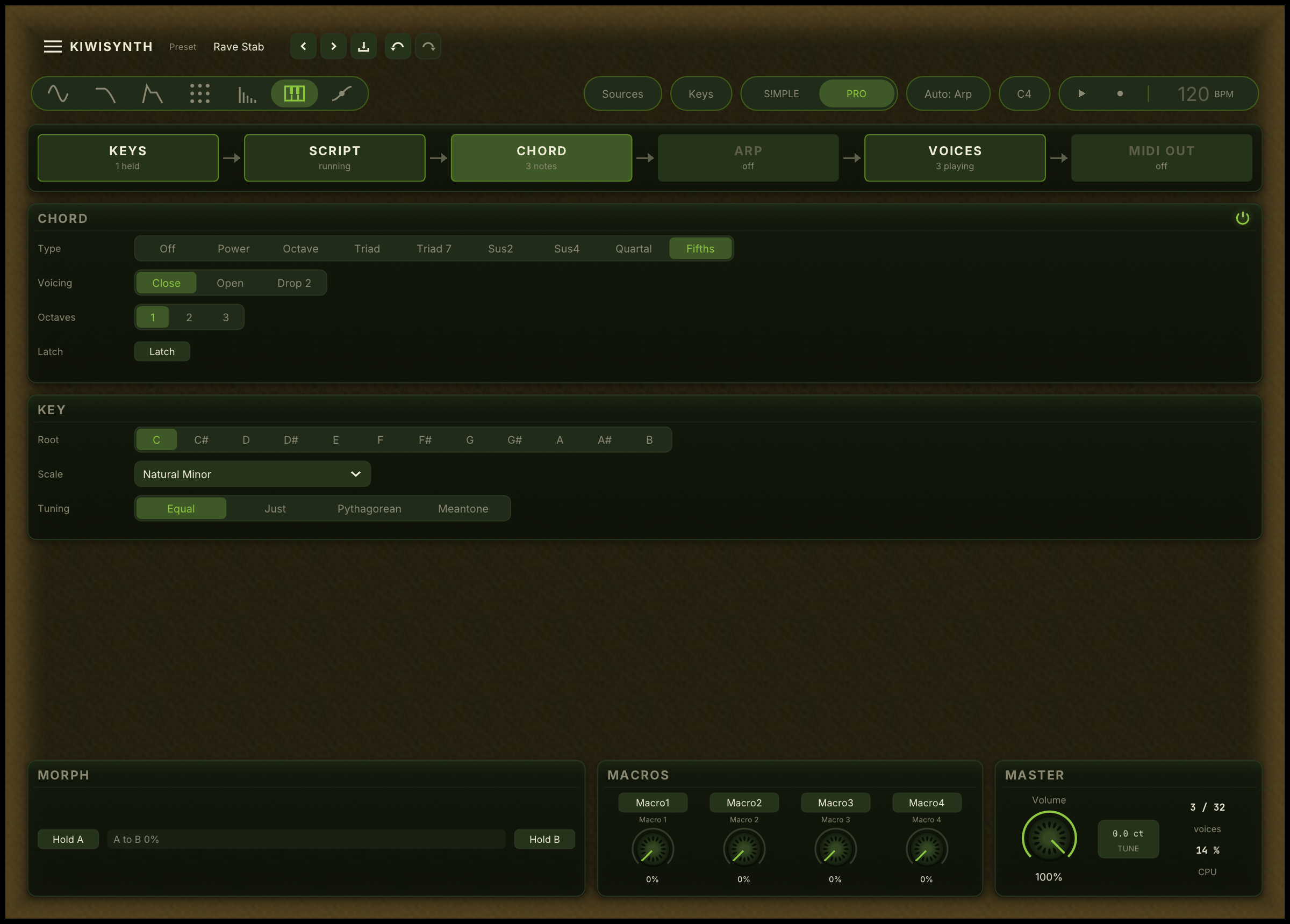
Chord
On switches the chord stage on and off.
Chord Type is the shape of the stack:
- Off passes the key through untouched.
- Power adds the fifth above, the two-note shape of a rock guitar chord.
- Octave adds the same note an octave up.
- Triad builds a three-note chord on the key you played.
- Triad 7 adds the seventh on top of that.
- Sus2 and Sus4 replace the middle note of the triad with the note a step below or above it, which takes the major or minor colour out and leaves the chord open and unresolved.
- Quartal stacks fourths instead of thirds. It sounds modern and ambiguous rather than major or minor, and it is the sound of a lot of jazz piano and film scoring.
- Fifths stacks fifths, which spreads wide and stays hollow.
Triad and Triad 7 follow the key. They are not a fixed pattern of semitones stacked on whatever you pressed: they take the notes from the scale, so the same setting gives a major chord on the first degree of a major key, a minor chord on the second, and a diminished one on the seventh. You do not choose the quality. You play a degree and the key decides. In Chromatic, where no scale is set, they fall back to a plain major triad and a dominant seventh.
Voicing is how the notes are spread out:
- Close packs the chord into one octave. It is tight, and low down it turns to mud.
- Open lifts every other note an octave, which opens the chord out and keeps the low register clear.
- Drop 2 takes the second note from the top and drops it an octave. It is the standard guitar and jazz-piano voicing, and it puts a note below the key you played.
Octaves repeats the chord in higher octaves. The chord is capped at eight notes however this is set, so one key can never exhaust the voices.
Latch keeps the chord sounding after you lift the key. The next key you press replaces it. Without Latch you have to hold the key down, and holding the key down is most of what a chorder exists to avoid.
Key, scale and tuning
Key is the root note. It decides which note the chord stage and a script call the first degree.
Scale decides which notes belong to the key. Chromatic is the default and means every note, so nothing is constrained. Choose any other scale and the chord stage can pick the right chord quality for each degree by itself, and a script's scale functions have something to snap to.
The scales are Major, Natural Minor, Harmonic Minor, the four common modes (Dorian, Phrygian, Lydian, Mixolydian), the two pentatonics, and Blues.
Tuning decides how the notes of the key are tuned. This is not detune. It is a fixed offset for each note of the octave, in cents, so an interval that is slightly wrong in the modern standard comes out exactly right.
- Equal is the modern standard and is the default. Every semitone is the same size. Every key sounds equally good and equally slightly wrong.
- Just tunes the notes to whole-number frequency ratios against the key. Chords in the home key stop beating: the third stops fighting the root, and the chord locks into place in a way that is hard to unhear once you have heard it. Play far from the home key and it goes sour, which is the trade Equal exists to avoid.
- Pythagorean has pure fifths and a wide, bright third. It is a hard, ringing sound, and it suits open fifths and modal writing better than triads.
- Meantone is the early keyboard tuning. It narrows the fifth to buy a pure third, so chords near the home key are sweeter than Equal and remote keys are rougher.
The tuning is applied when the note starts, not swept in afterwards, so a note is in tune from its first sample.
What this does not do
It does not read Scala or tun files, and it does not support more than twelve notes to the octave. The tunings here are the four listed above and nothing else.
It does not detect the chord you are playing. It builds a chord from the one key you pressed. Hold three keys with Chord on and you get three chords.
Notes
The chord stage counts references, so a note shared between two chords keeps sounding until both keys are lifted. Play C and then E in C major and the two triads share a G; release C and the G stays, because E still needs it.
The key and tuning are saved with the whole patch, not with a section. Loading a single section of a preset can never silently retune you.