Early Preview · Kiwisonic and Kiwisynth are free during early preview. The shape of both products is still being figured out, and feedback is what drives them forward.

Make music, even if you have never written a note

You do not need to know scales or chords to start. Kiwisonic keeps you in key, shows you what sounds good next, and lets you learn by listening. Pick a genre and you are composing in minutes.

It tells you what comes next

A melody is just one note after another. When you are not sure which note to pick, turn on suggestions. A small set of options appears right where you are working, each one coloured and labelled in plain words. Green is a strong choice, amber is a fair one, red is a weak one. Red still appears, because the colour is advice rather than a rule. You listen, and you choose.

  • Hover an option to hear it before you commit, then click to place it
  • Labels describe the feeling, like "comes home, releases the tension", not the theory
  • Place a note and the next set appears, so you build the tune one step at a time
  • The options come from your key and stay near your last note, so the line stays singable
  • Near the end of a phrase it offers a rest: letting a tune breathe is something beginners almost never do
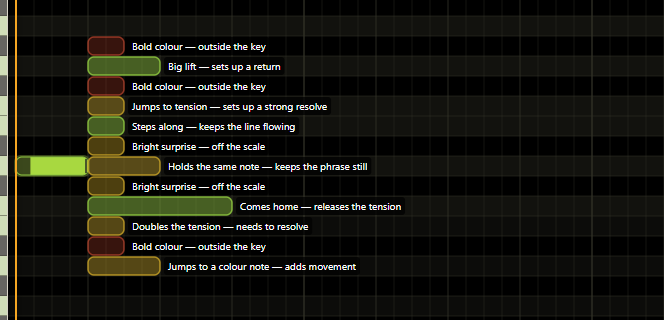
Next-note suggestions at the cursor

You cannot play a wrong note by accident

You write notes by clicking on a grid: click to add a note, drag it to move it, drag its edge to make it longer or shorter. The notes that belong to your key are bright, and the ones that do not are dimmed. You can still use any note you want, but the grid quietly keeps you on safe ground while you find your way.

  • Click to place, drag to move, drag the edge to change the length
  • Out-of-key notes are dimmed, so the safe choices stand out
  • Press play any time to hear what you have so far
The Kiwisonic note grid

Press a number, get a chord

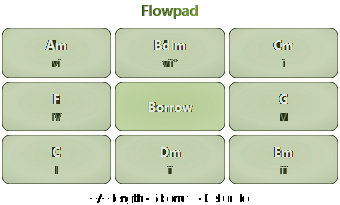
Chords are the backing that a melody sits on. The FlowPad lays out every chord that fits your key on a 3 by 3 grid, shaped like a numpad. Press a number to add a chord. After each one, the grid colours the others to show what follows well: green is a smooth, common move, yellow adds colour, red builds tension. You pick by ear, and the colours guide you.

  • Every chord on the pad already belongs to your key. No theory knowledge needed
  • The colours update after each pick, so you always see the good next steps
  • The chord positions never move, only the colours change, so the layout becomes muscle memory
  • Press 0 to rest for a bar, or 9 for the parallel tonic, which shifts the mood from major to minor
The FlowPad with its flow colours

A beat by switching cells on and off

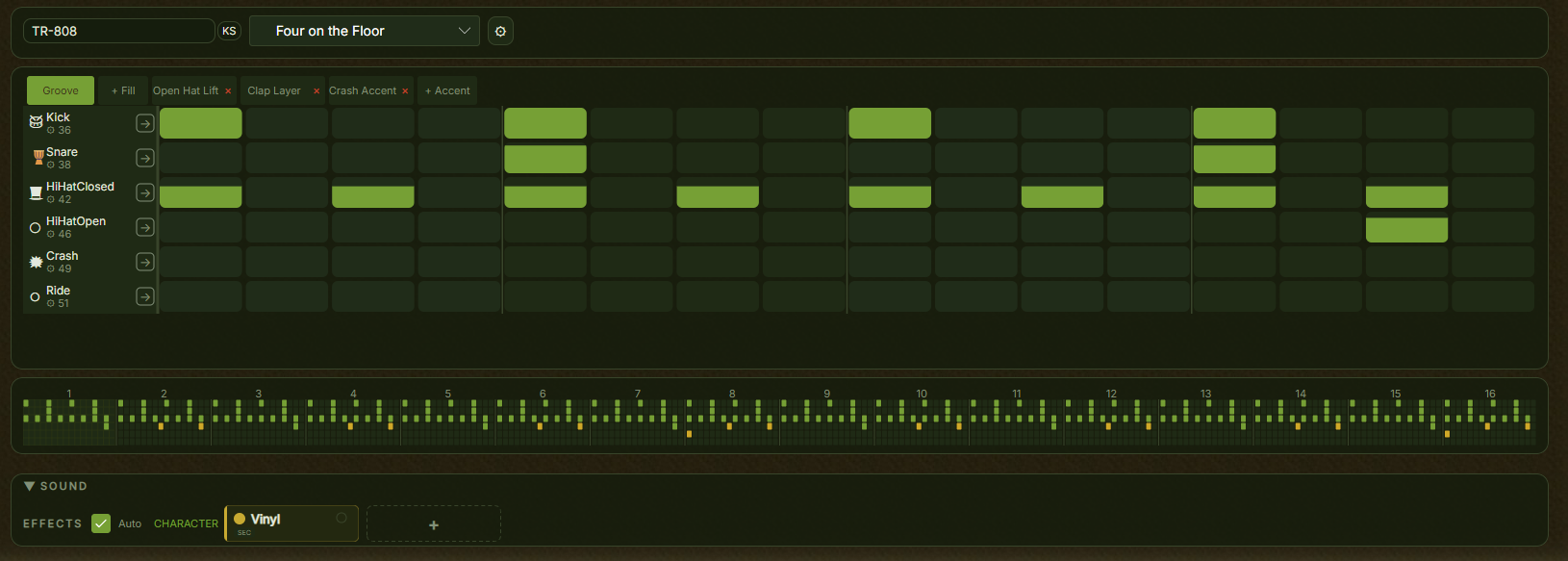
The drum editor is a grid of buttons, one row per drum sound. Click a cell to place a hit, and the row repeats to make a beat. There is nothing to tune and nothing to learn first: try a kick on every beat, scatter some hi-hats above it, and you have a groove.

  • One row each for kick, snare, hi-hats, and more, ready to use
  • Click to add a hit, click again to remove it
  • The pattern loops, so you hear the beat take shape as you go
The drum step sequencer

Lay out a whole song, not just a loop

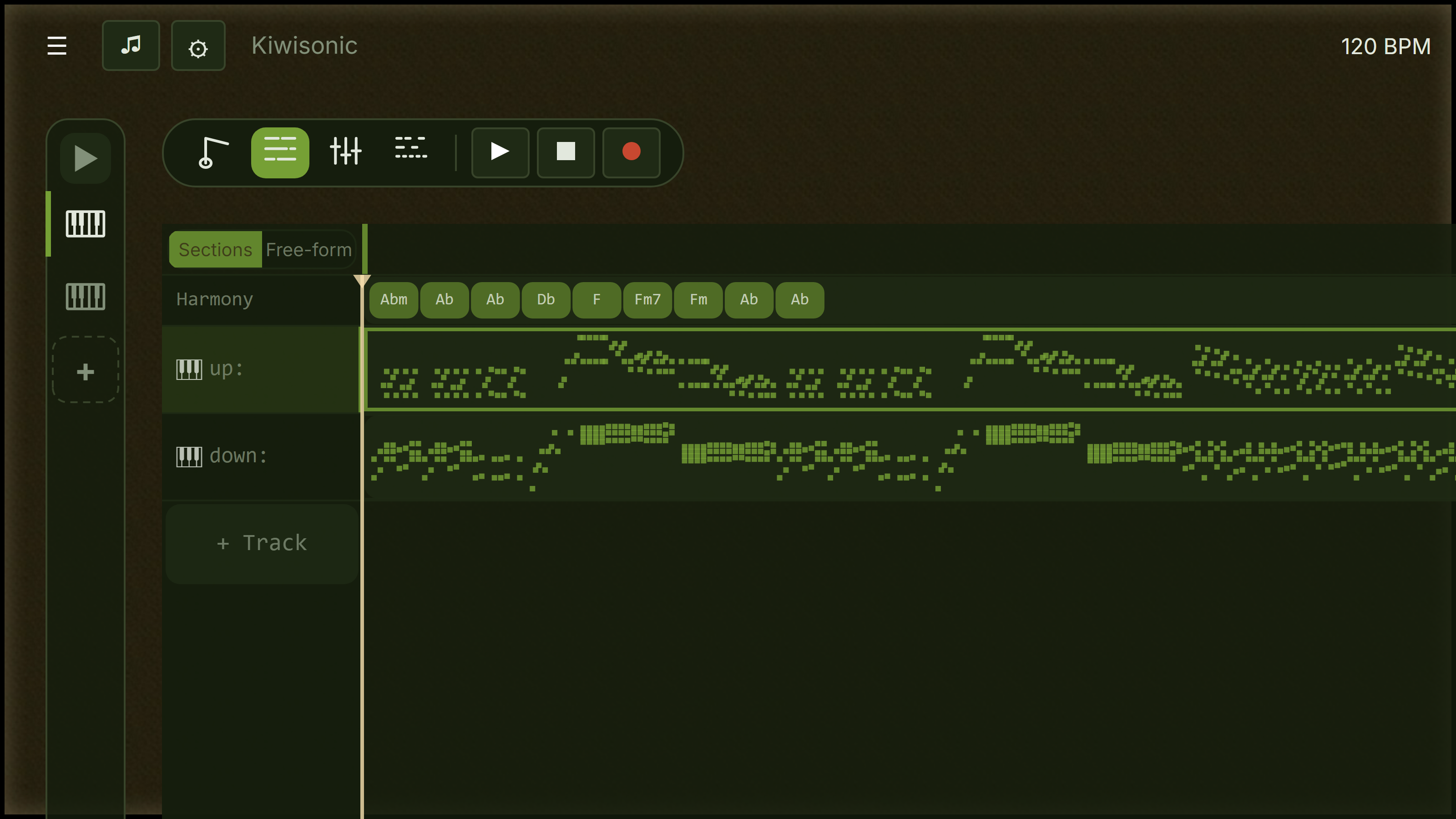
A song has parts: an intro, a verse, a chorus. In Kiwisonic those parts are sections in a grid, with the sections along the top and your instruments down the side. Fill in the squares. Each section can play something different, so your chorus can lift away from your verse, and the shape of the whole song stays in front of you the whole time.

  • Drag a section to reorder it, and the whole song follows
  • Each section holds its own pattern for every instrument
  • Copy a section and change it, so a second verse can grow from the first
  • Kiwisonic knows a chorus should lift and a quiet part should hold back, so the parts it writes fit where they sit
The arrangement timeline

Pick a genre and start from the right place

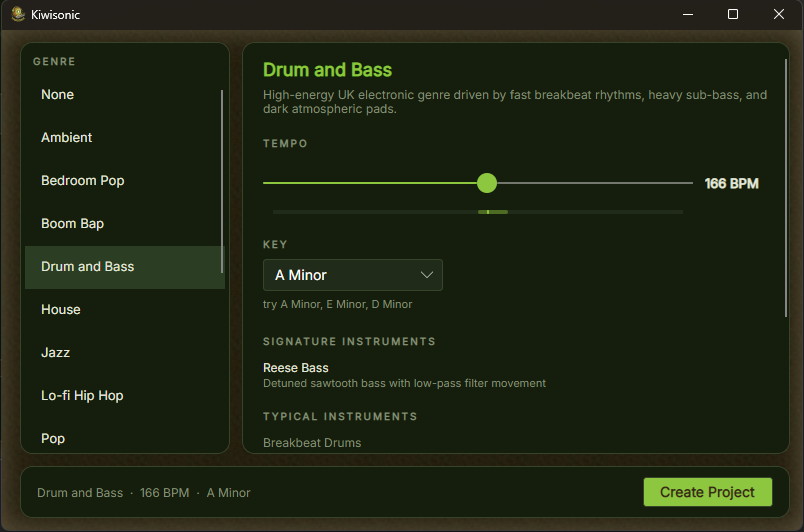
When you make a new project you choose a genre, and Kiwisonic sets the scale, the kinds of chords, and a starting set of instruments to match. The instruments are ready the moment you launch, with nothing to install and, on most of them, nothing to set: an electric piano, and the TR-808 and TR-909 drum machines.

  • The scale and chord suggestions shift to suit the style you picked
  • The electric piano has no settings at all. It is one sound, and it is a good one
  • Reach for the 808 when you want a deep, booming kit, and the 909 when you want a tight, driving one
  • Kiwisynth, the bundled synth, has a S!MPLE mode you shape by feel. See Kiwisynth for beginners →
Choosing a genre for a new project

Start with your first melody

Free during early preview. Windows 10 / 11. No payment, no account required. When the basics feel easy, the full guide shows what is next.

Download Kiwisonic