A monophonic bass instrument. You draw how the sound moves across up to sixteen bars, a wander keeps each pass from repeating the last, and the same bar still bounces the way you heard it. Underneath sits a clean mono sub that no setting can widen or distort. Standalone editor for Windows, CLAP plugin for Windows and Linux.
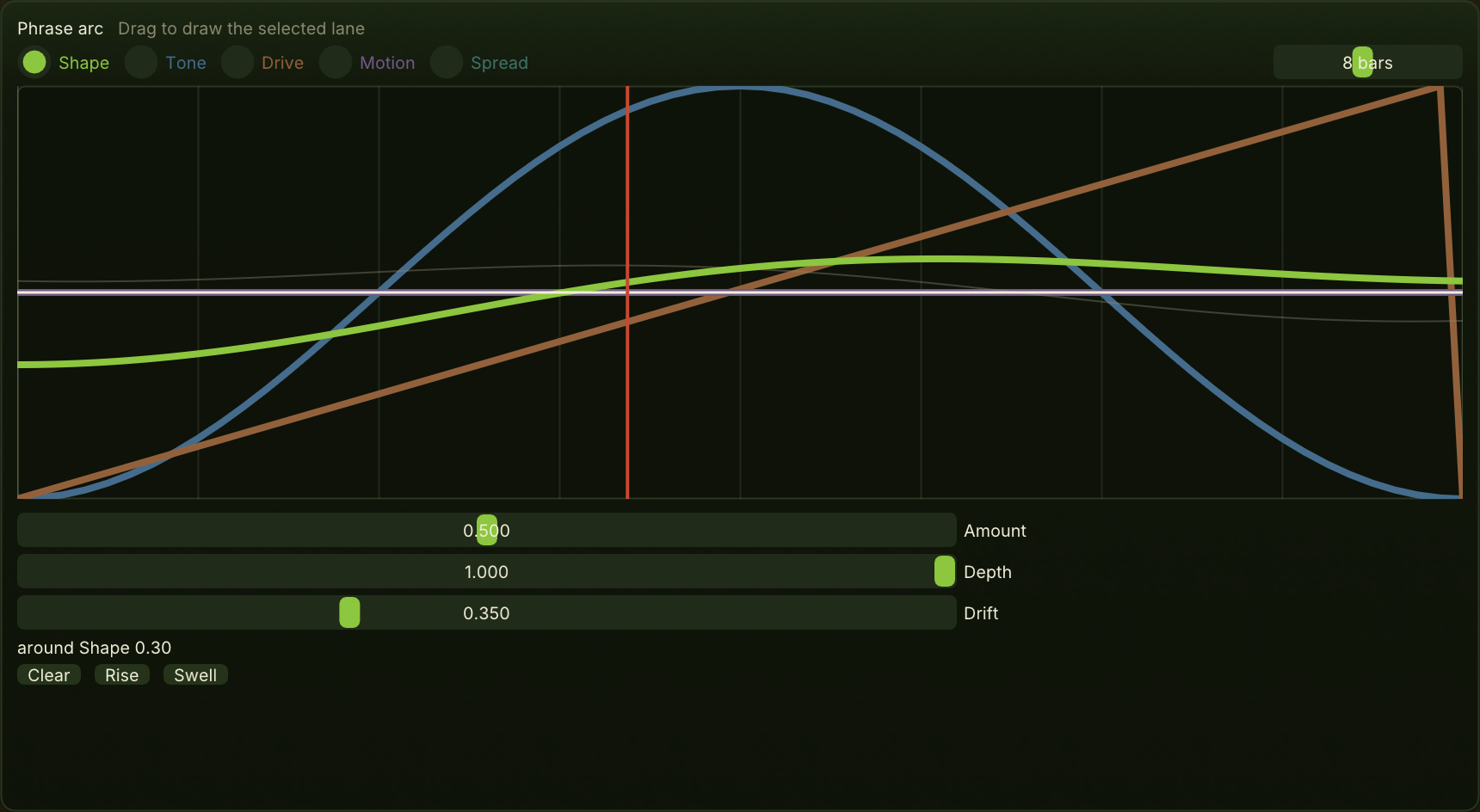
A two-note bassline sounds looped because every bar is the same. The Arc tab is one canvas for the whole phrase: a lane each for Shape, Tone, Drive, Motion and Spread, drawn across 1 to 16 bars and locked to the transport. A wander rides on the drawing so no pass repeats the one before, yet it follows song position, so the same bar plays the same way on every playback and a bounce matches what you heard.
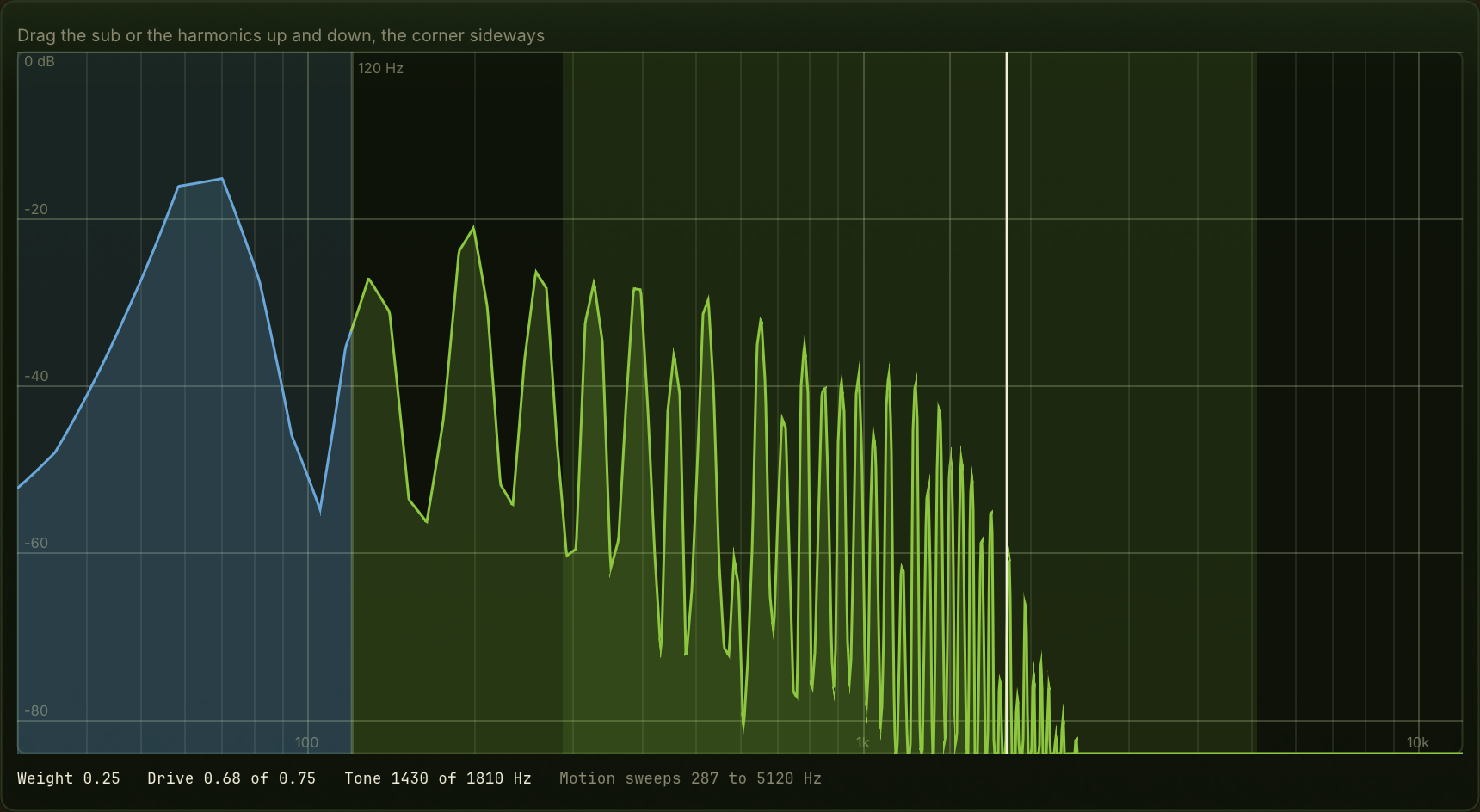
You set a bass's balance by looking at it. The Spectrum tab measures the engine at the note you are playing and shows the sub against the harmonics above it, with the crossover standing as a wall between them. Drag the sub up or down and you set Weight, drag the harmonics and you set Drive, drag the filter corner sideways and you set Tone.
The sub is a mono sine by construction. Width and drive exist only above the crossover, and no control turns that off, so a patch cannot phase-cancel its own bass. Other instruments offer a mono-bass option you have to remember to enable. Here there is nothing to enable.
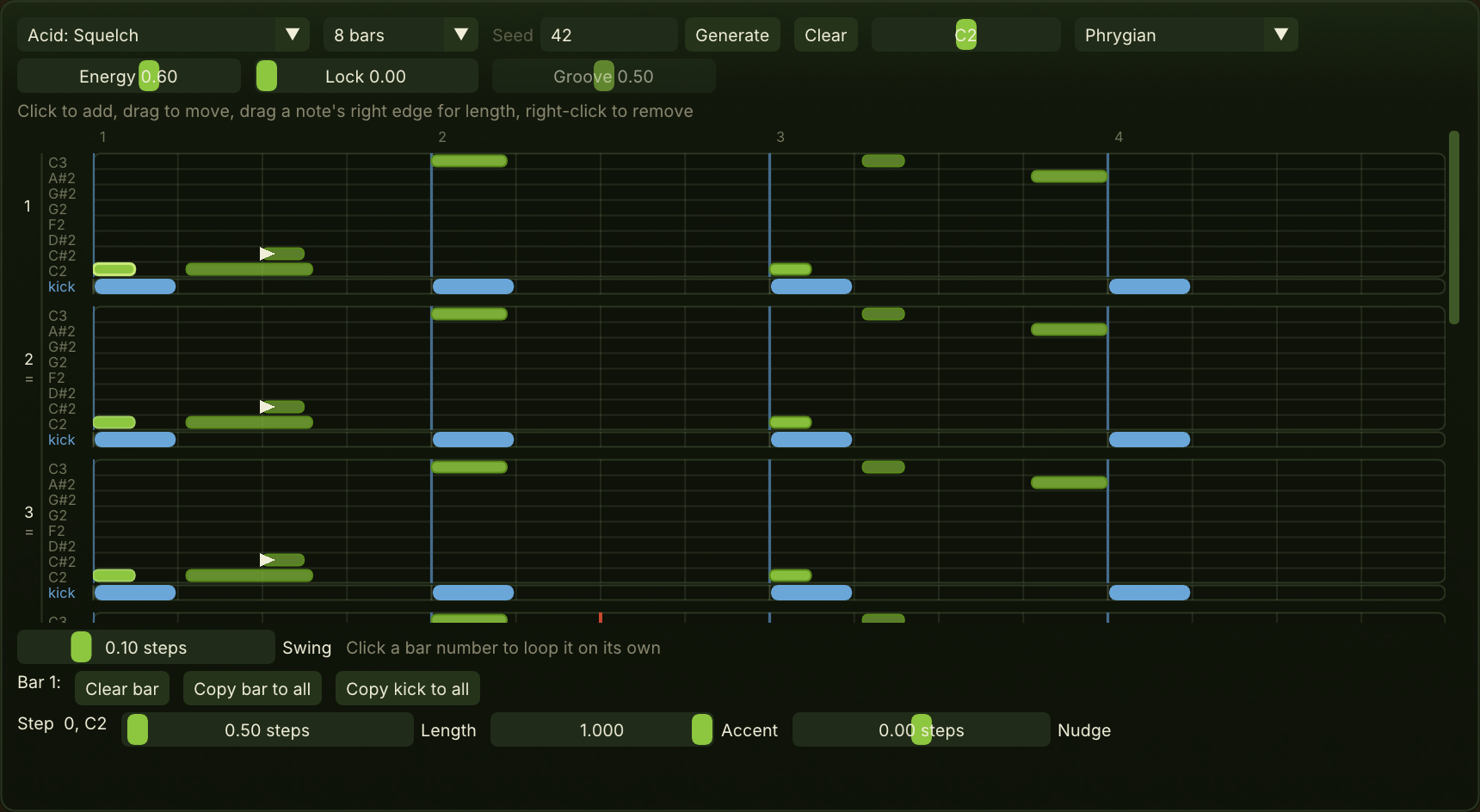
A bassline is only right against its kick. The Pattern tab draws each bar of bass above a kick row, and Generate writes the line against that kick: Lock sets how firmly it holds to it, Groove whether it sits on the kick or on its offbeat, Energy how much it plays. Every pitch lands in the scale you chose.
The generator follows genre rules from a seed, so the same seed, with the same line preset, settings, key and kick, always writes the same line. Write the number down and the line comes back; send it to someone and they get it too. A line you have edited by hand after generating is your own, and no longer its seed.
No position of any macro is silent, clipping or off-level, and the test suite holds it to that. Turn anything anywhere and you get a sound worth judging. It is a promise about levels, not about taste.
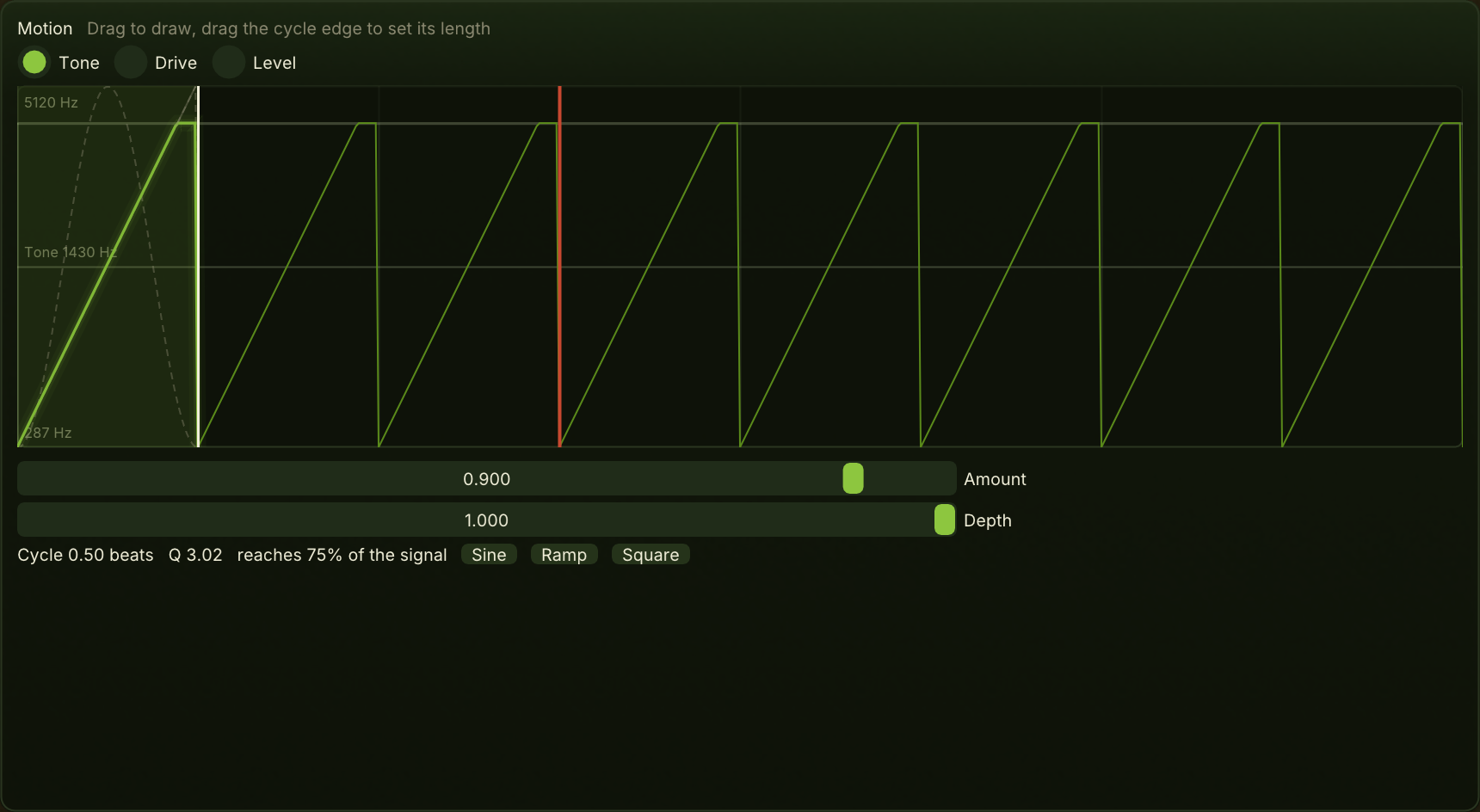
Where the arc moves over bars, Motion moves over beats: a filter sweep, a pumping level, a drive that breathes. Draw one cycle and set its length by dragging its edge; it snaps to lengths that sit on the beat, from a sixteenth up to four bars.
The Voice panel sits under every tab and sets how each note starts, holds, slides and spreads. There are no knobs: each control is a picture of what it does, and you drag the picture.
Punch is a drop in pitch into each note, not a click in level. Shape runs from a pluck that decays to a swell that grows, along one law. Glide sets how long a slide takes, and Legato decides whether an overlap ties or strikes anew.
The waveform under the canvas renders the current sound playing the current notes over several passes, with heavier lines where each phrase starts over. It shows what the arc does to the audio, which live listening lets you hear only once.
A patch is the sound, drawings included, and lives in a shared preset folder that the standalone and the plugin both read. A session keeps the patch and the pattern together. Factory patches cover Sub, Reese, Pluck, Acid and Growl.
Kiwibass comes as two downloads. The standalone, on Windows, is the editor: every canvas on this page lives there. The plugin is a CLAP instrument for Windows and Linux, with the same engine, so the same patch sounds the same in both.
Your host's CLAP preset browser lists the factory patches and every patch you saved in the standalone, by name and category. Picking one loads the whole sound: every setting, the arc lanes and the motion cycle.
The arc and the motion cycle follow the host's transport, so the same bar plays the same way on every playback and a bounce matches what you heard. The project keeps every parameter and every drawing.
The plugin has no editor of its own: your host shows its parameters as sliders. The pattern leaves the standalone as a MIDI file. A host that does not list CLAP presets cannot load a saved patch.
Kiwibass is measured against the bass instruments you might buy instead, the synths and effects that draw movement, the bassline writers, and the hosts you already have open.
SubLab XL, Subcraft, Monoment Bass, SubBoomBass 2, Cyclop, LØW, Acid V, Phoscyon 2 and ABL3. None of them draws a phrase across bars or shows the sub against the harmonics measured at the note you play. Monoment Bass has Sub Mono with an adjustable crossover: switched on, the result matches. The difference is that Kiwibass cannot be switched otherwise.
Serum 2, Vital, ShaperBox 3, Transit 2, Massive X and Pigments. Multi-bar movement is not new: ShaperBox draws curves up to 32 bars, Transit 2 one gesture up to 16, Massive X Performers up to 8. Where they vary a sound from pass to pass, it is at random. Kiwibass makes the phrase the canvas a bass is designed on, with a wander that plays back the same way every time.
EZbass and Logic's Bass Player follow a real drum track, which Kiwibass does not: it writes against the kick row you draw in its own editor. FL Studio's Riff Machine also writes from dice seeds. Captain Deep, Bass Dragon and Riffer round out the set.
Ableton Live's Auto Filter puts a filter handle over a live spectrum, and Sting plays from a fixed set of patterns. Neither shows the sub against the harmonics, and neither writes a line from a seed you can share.
| Voice | Monophonic. A mono sine sub below a 120 Hz crossover, a harmonic layer above it that takes Drive, Tone and Spread |
| Arc | 5 lanes (Shape, Tone, Drive, Motion, Spread) across 1 to 16 bars, with Amount, per-lane Depth and Drift |
| Motion | 3 lanes (Tone, Drive, Level), one cycle from a sixteenth to four bars |
| Playing | Velocity moves level, drive, punch and tone together. Note length sets the release. Legato glide on overlapping notes |
| Pattern | 4, 8 or 16 bars, genre line presets, 6 scales, seeded generation against a drawn kick, swing and per-note nudge |
| Export | MIDI (the pattern) and WAV (the current sound playing the current notes) |
| Patches | Shared by standalone and plugin, drawings included. Factory patches in Sub, Reese, Pluck, Acid, Growl and Other |
| Formats | CLAP plugin for Windows and Linux, no editor of its own. Standalone editor for Windows: plays the demo line or your pattern, no MIDI keyboard input |
The standalone editor and the CLAP plugin. Free during early preview. The manual covers every control, and its guides draw a phrase that opens over eight bars and write a line against a four-on-the-floor kick. The buttons fetch the build for your system; other platforms and install notes are on the download page.